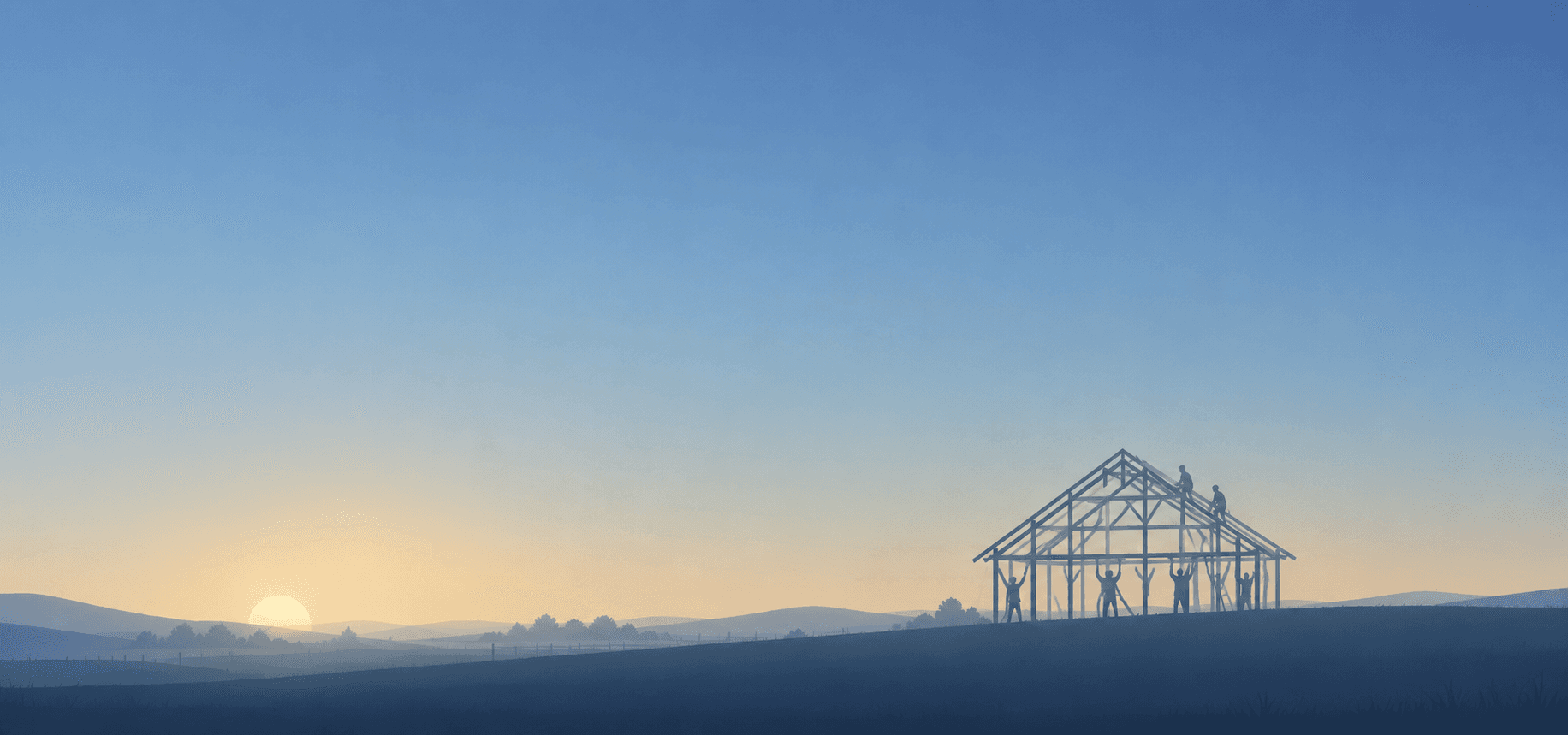
Neighbors raising a timber frame against a misty sunrise

Next Raise · The Unhoused

Rogue Raise

Friday–Sunday · October 23–25, 2026

What happens when a community points its superpowers at the civic challenges no one can solve alone?

The Idea

A Rogue Raise is White Rabbit’s community build event: a focused, roughly 48-hour gathering inspired by the old barn raise, where neighbors came together to put up something none of them could build alone.

Instead of a barn, we raise tools: working software and practical solutions aimed at a real problem facing the Rogue Valley. We point the creative energy of our community at it: coders, designers, and people who are just good with their hands.

But a Rogue Raise is not a hackathon in the usual sense. Hackathons run on instant gratification and the all-nighter, the thrill of showing off what you can build by Sunday. A Raise is slower. We come together to raise something that outlasts the weekend.

Next Up · Rogue Raise: The Unhoused

Next, we turn to homelessness.

Friday–Sunday · October 23–25, 2026·White Rabbit, 5 North Main Street, Ashland·Event details →

The next Rogue Raise takes on one of the hardest and most contested issues in the Rogue Valley. The federally required Point-in-Time count happens once a year, in January. That’s one of the worst possible times to take an accurate measure: many people have left the area or are sheltering out of sight. Resources get allocated against a picture almost everyone agrees isn’t true.

The problem isn’t a lack of compassion. It’s that the data is broken.

When the data is shaky, it can be turned against the very people it’s meant to serve. Louder advocacy won’t fix that. A foundation of trustworthy, defensible data can. When the numbers hold up to scrutiny from every side, the people whose job is to bridge data and decision-making can walk into a commissioner’s meeting and say: this is real, and here’s why the resources aren’t reaching where they’re needed.

What we’ll build

This Raise helps a local public-health team build the data infrastructure to tell the true story of homelessness in our region, and to keep telling it over time instead of once a year. The work breaks into three buckets.

01

Clean the data we have

Build a way to de-duplicate records and match the same person across many encounters: a lightweight, CRM-style system with confidence-based matching and persistent IDs, so one person isn’t counted as three.

02

Make the count better

Improve the Point-in-Time count with tools that work in the field: offline-capable mobile collection (not fixed kiosks, which invite vandalism), backed by a web dashboard.

03

Add new data

Bring in signal that doesn’t exist today, from places like meal programs and syringe exchange and community reporting, plus the volunteer pipeline to gather it ethically and consistently.

The foundation underneath it all

Syndromic surveillance (an ongoing, week-over-week public-health method, with established CDC code libraries to build on and a promising precedent in New Mexico) creates a reliable baseline. That baseline is what makes a better, more frequent count possible, and what lets the region finally see trends instead of a single January snapshot.

Our north star

A Raise on this topic only works if the people it’s about are in the room.

We’ll open by hearing directly from unhoused community members, in a real conversation about what they need and what they want to say, rather than a survey we’ve imagined for them. Giving people a way to advocate for themselves is the whole point, and we build the weekend around it.

A room full of well-meaning people once planned how to get more food out to the community. Peanuts, bulk packs, fresh vegetables. Then one woman finally pointed out that the people they were talking about largely can’t chew them.

Good intentions are not the same as listening.

The human truth

A first-person story

The lived experience that builds empathy and can't be reduced to a statistic. The thing that moves someone who wasn't already moved.

The data truth

A credible, defensible count

The quantitative story that can move county commissioners and state representatives because it holds up to scrutiny from every side.

Both are needed; one without the other persuades no one new.

How a Raise works

Four moves, over a single weekend.

01

Opening ceremony

We begin by hearing from stakeholders, the people closest to the problem, including those directly affected by it. Teams then form around different facets of the challenge.

02

The build

Teams work the problem in parallel over the weekend, demonstrating what collective creativity and modern tools can do when focused on a single shared question.

03

Presentations and judging

At the end, teams present back to the community. Real users, the people who would actually use what gets built, sit on the panel. They judge each project on one thing: would you actually use this?

04

An owner for what we build

We hand every project off to a real owner tied back to the stakeholders, so the work doesn’t end as a cool demo nobody uses. If the community can’t pick it up and run with it, it isn’t finished.

Two commitments guide every Raise

Humanity

Serving the people we're here to help

Every decision starts from the humanity of the people our community is trying to help, before anything clever or impressive we could build.

Truth

Getting as close as we can to what's real

Every decision downstream depends on a foundation of honest data and lived experience, so we get as close as we can to what is actually true.

Rogue Raise #01 · Wildfire

We started with fire.

Our first Rogue Raise took on wildfire, the defining risk of life in the Rogue Valley. Over a single weekend, teams worked alongside a community partner, Charisse Sydoriak of the Plant List Generator, to turn fragmented, privately held data into practical tools the region could use. The work strengthened a grant-backed organization already serving on the front lines.

That first event shaped the model we use today. The lessons it taught us are the ones we carry into every Raise since:

The people closest to a problem have to be in the room from the start.

The most valuable thing we can build is something with a clear owner who will carry it forward.

A beautiful tool nobody uses is a failure, no matter how impressive the code.

Come help us raise something real.

Whether you write code, design, work in public health or social services, or simply want to lend a hand the way neighbors always have, there’s a place for you at the next Rogue Raise.

Sign up to build →

Friday–Sunday · October 23–25, 2026 · White Rabbit, 5 North Main Street, Ashland · Event details